You normally write the PLC"Programmable Logic Controller" A Programmable Logic Controller, PLC, or Programmable Controller is a digital computer used for automation of industrial processes, such as control of machinery on factory assembly lines. Used to synchronize the flow of inputs from (physical) sensors and events with the flow of outputs to actuators and events program. Whereas Kollmorgen application team members create in most cases the motion controlMotion control is a sub-field of automation, in which the position and/or velocity of machines are controlled using some type of device such as a hydraulic pump, linear actuator, or an electric motor, generally a servo. Motion control is an important part of robotics and CNC machine tools; however, it is more complex than in the use of specialized machines, where the kinematics is usually simpler. The latter is often called General Motion Control (GMC). Motion control is widely used in the packaging, printing, textile and assembly industries part.
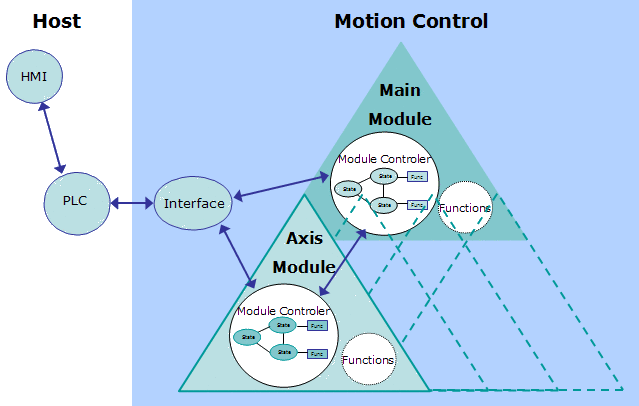
The global software structure is built up with different modules placed on two different levels as showed on the figure below:
Figure 11-28: Software Structure Overview
Module Definition:
To have the structure running as a real application, it needs to be controlled by a PLC. As the PLC is not part of the application structure, only the main and axis modules are described here.
The main module controls the functional work that globally affect the application (e.g. multi axes functions). It receives commands from the PLC and sends back acknowledgements. The main module does not directly act on the physical axes, but controls the axis modules that are linked to them.
Communication between main and axis modules is done via internally defined data channels.
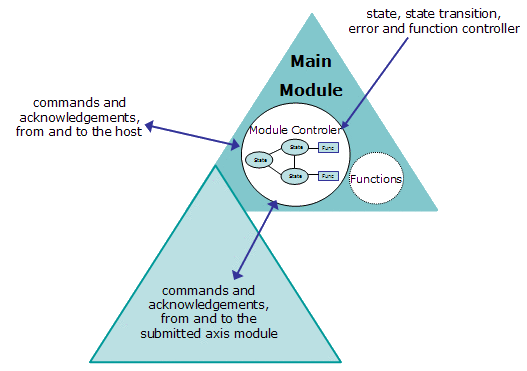
Figure 11-29: Main Module Description
As shown on the figure, the main module consists of two parts:
The axis module controls the functional work that affect the application one or more physical axes (e.g. single-axis functions). It receives commands from the PLC and sends back acknowledgements.
The axis module also communicates with its main module via the internally defined data channel.
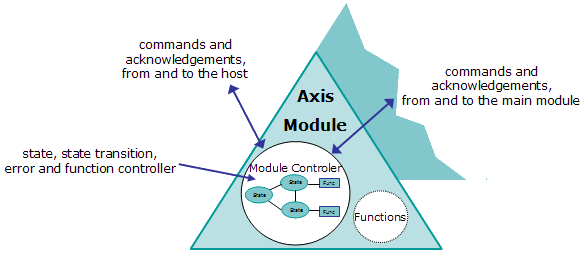
Figure 11-30: Axis Module Description
As shown on the figure, the axis module consists of the same two parts as the main module:
|
Stay Connected with Kollmorgen       
|
Copyright © 2015 Kollmorgen™ |

|